

Wide Plank Pine Floors

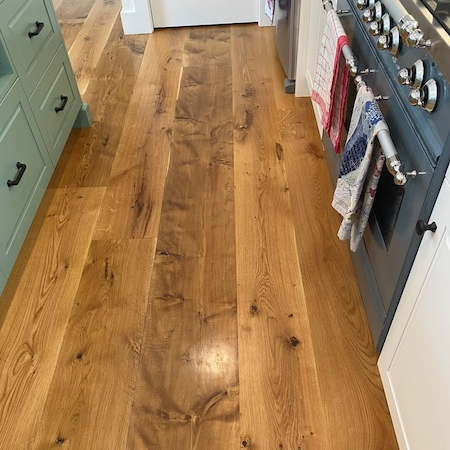
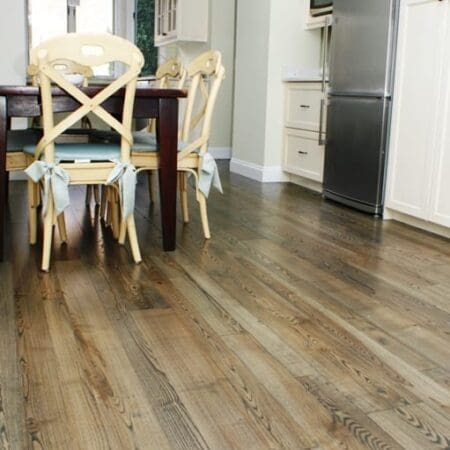
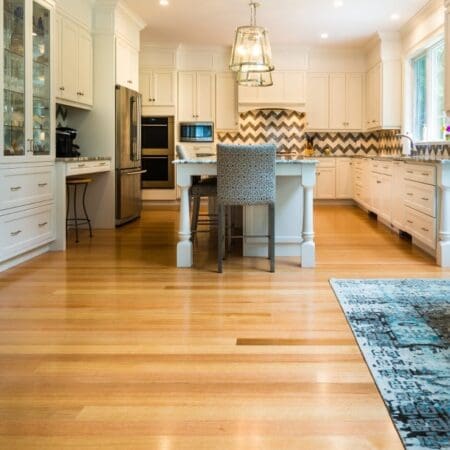
Figure 1: Newly sawn Eastern White Pine + a custom stain + pure tung oil for a matte finish = an antique looking wide pine floor, from $4.27/square foot.

The first floors we milled at Hull Forest Products nearly fifty years ago were wide pine floors, and wide plank pine continues to be our best selling wood floor. New England homeowners ( and many others with antique, farmhouse, or period inspired homes) love traditional wide pine. There is something about the width and length of the planks, the large sound red knots, and the patina that develops that makes a wide pine floor charming. The floor has an heirloom quality.

Customers often come to us looking for a floor that emulates the look and feel of old pumpkin pine or heart pine at a reasonable price, so we show them how our clients have chosen to finish their floors to mimic the look of an antique floor. See Figure 1 above for an example, and check out our pine flooring gallery for many others.

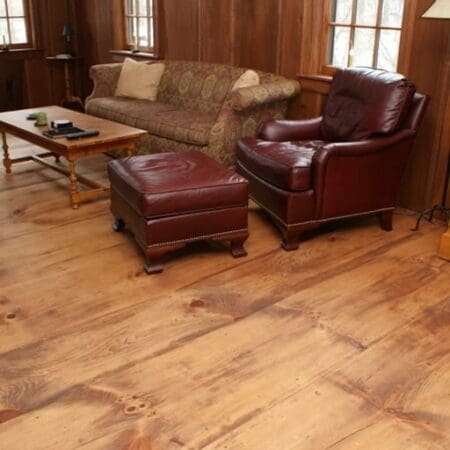
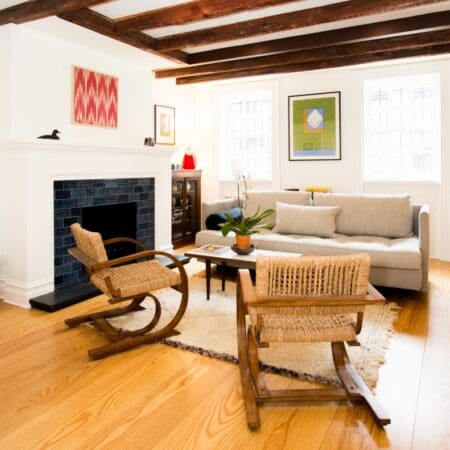
Some of you may be familiar with the living history museum, Old Stubridge Village. They used our wide pine for the floor of their Oliver Wight Tavern Building. If you get a chance to visit there, be sure to check out this floor (shown in Figure 2 below).  It is an interesting example as it had no finish applied at all and has been left to weather the heavy public foot traffic in the buff.

Our wide pine flooring in use at Old Sturbridge Village in the Oliver Wight Tavern. OSV applied no finish to the floor, preferring to let it age naturally.

Figure 2: Our wide pine flooring in use at Old Sturbridge Village in the Oliver Wight Tavern. OSV applied no finish to the floor, preferring to let it age naturally.

We source our flooring grade pine from the historic Myers Pond and Yale University Forests in Connecticut, harvesting only during the cold winter months so we get the best color retention.  We mill our wide pine flooring from logs predominantly twelve feet and longer, selecting  for even growth and live red knots.

Wide pine flooring lovers are often history buffs, so you may be interested to know that the Eastern White Pine tree played a role in the American Revolution. Because it grows so tall, Eastern White Pine has long been used for the masts of ships, and the British Navy tried to reserve the tallest White Pines in the colonies for the masts of British naval vessels. When an act to this effect was enforced in New Hampshire, it outraged the colonists. Though forbidden to cut “any pine tree of the growth of 12 inches of diameter,” it became unfashionable to have floorboards in one’s home that were less than 12 inches wide.

In 1772 a sawmill owner in Weare, New Hampshire was arrested and fined when white pine logs with the king’s broad arrow mark were found at his mill.  He and a group of about 40 townspeople rioted, attacking the sheriff and his deputy and literally running them out of town in what became known as the Pine Tree Riot.  This act of rebellion against British authority was an inspiration for the Boston Tea Party, which took place the following year.

Visit our gallery of wide plank pine floors for more information on the merits of Eastern White Pine and to browse photos showing how the application of stains and/or finishes can change the look of this floor.


Oak Wide Plank Floors

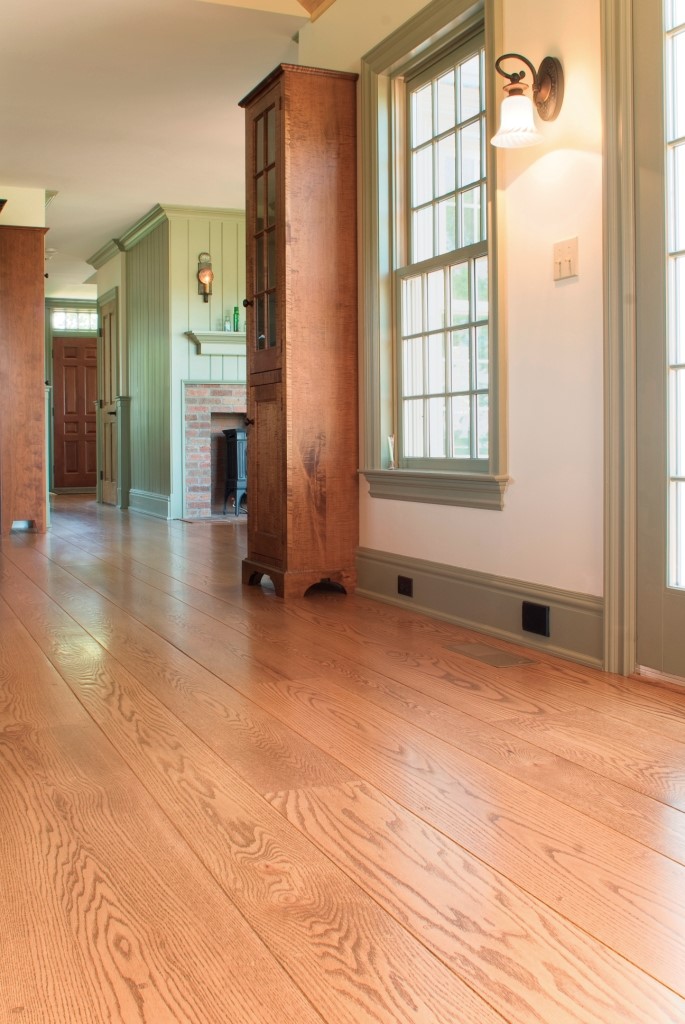
Red Oak wide plank flooring, Norwich, Connecticut

Wide board red oak flooring brings a sense of history to this reproduction colonial home. Wider planks allow for a fuller view of the "cathedral window" grain common to oak.

Oak. Quercus.

How do you tell the difference between red oak and white oak flooring? Well, for one thing, there is the price tag (red oak generally costs less than white oak.) Appearance wise, red oak tends to have ruddy undertones that are pinkish to red, while white oak’s undertones tend to be more gray to brown. But it is not always easy to distinguish the two. With the application of stain and/or finish, each can be made to look more like the other.

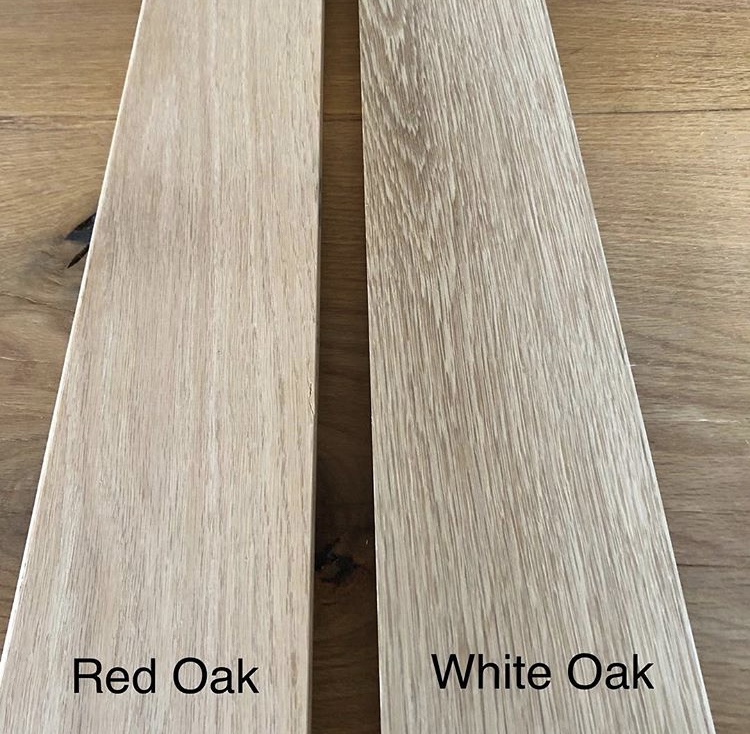
A more accurate way of distinguishing these two species within the Oak genus is by comparing ray length.  Rays are vascular tissues in the tree. (Think of them as drinking straws transporting food, water, nutrients, and minerals to all parts of the tree.) In flatsawn wood, these rays appear as horizontal lines, while in quartersawn wood, they can appear as wavy lines. The rays of red oak are noticeably shorter than those of white oak. (Compare figures 1 and 2 below).

Detailed view of the rays in the grain of Red Oak.

Figure 1: Close-up view of the rays (the darker horizontal lines) in the grain of Red Oak.

Close up view of the rays in the grain of white oak.

Figure 2: Close-up view of rays in the grain of White Oak. Notice how these are longer than those of Red Oak shown in Figure 1.

Differences in ray length are most obvious when you can compare red oak and white oak boards side by side.

It’s no secret in the flooring world that red oak, for over a decade, has been the poor cousin in the oak family, taking a backseat to its more popular relative, white oak.  This trend reflected a backlash against the ubiquity of red oak strip flooring, which once accounted for the majority of flooring installations in the United States.  But when you enter the realm of wide plank flooring, red oak becomes something very uncommon.  Wide plank red oak flooring shows off the bold cathedral grain of oak in a way that is simply not possible with the narrow boards of strip flooring, which means that wide plank red oak flooring looks very different from 95 percent of the red oak floors in the world today. Personally, we feel the bias against red oak is unjustified and that it is just as beautiful as white oak.

You may be wondering how the subtle differences between red and white oak translate to the appearance of an entire floor, so here are some photos that can help. For comparison purposes, both figures 3 and 4 below show select grade oak floors with an oil-based clear poly finish.

Figure 3: Red Oak in the select grade with a clear oil based poly finish.

Figure 3: Red Oak in the select grade with a clear oil-based poly finish.

white oak select with a clear oil based poly finish

Figure 4: White Oak in the select grade with a clear oil-based poly finish.

As you can see, with a clear oil-based poly finish, the red and white oak floors look very similar. The oil-based finishes are known for imparting an amber or yellowish glow. In contrast, water-based finishes give you more of a clear coat over the natural wood and do not amber with age. Here are some  examples of red oak and white oak with clear water-based finishes:

Quarter/rift sawn white oak with a clear water-based poly finish.

Figure 5: Quarter/riftsawn Red Oak floor with a clear water-based poly finish.

White Oak with a water-based poly finish.

Figure 6: White Oak with a clear water-based poly finish.

The end result from the water-based poly finish is a much paler floor in both cases, as shown in Figures 5 and 6 above. Now let’s see what happens when red and white oak are given a stain before being finished. The large pores in oak are particularly receptive to stain, so whether you start with red oak or white oak, a wide variety of color can be achieved, from pickled white to dark espresso.

Red oak floor with Bona Early American stain and poly finish.

Figure 7: Red Oak flooring with Bona's "Early American" brown stain and clear poly finish.

Frye Boot Store - Hull Flooring

Figure 8: White Oak flooring darkened with an aniline dye stain, at the Frye Boot flagship store, Manhattan.

As you can see, virtually any color can be achieved when you change the natural color of the wood with stains or dyes. Since monitor colors vary and since the light in your home will affect the view of your floor, the very best way to make sure you are happy with the species and color of your floor is to test out your stain and/or finish choices on samples of the raw woods.  At Hull Forest Products, we offer complimentary raw wood samples so you or your designer or contractor can experiment.  After all, if you’re going to be living on our slice of nature for years to come, we want you to love the way it looks.

For pricing, specifications, and more photographs, please visit our red oak flooring and white oak flooring galleries online at http://www.hullforest.com.

Hickory Wide Plank Floors

American Hickory wide plank flooring select grade

Figure 1: Hickory wide plank flooring is renowned for its resilience and beauty. Note the color variation, which is typical of Hickory and which is at home in either a modern or a rustic interior. The floor shown is a select grade of Hickory, with few to no knots.

Hickory. Carya.

It’s hard to imagine a wood that conjures up the image of the American frontier more than Hickory, which has a distinguished American pedigree. Hickory trees are found throughout eastern North America, and “Hickory” is one of the few extant Algonquin words.  Along with moccasin,  tomahawk, and hominy, the word pawcohiccora, from which hickory derives, was among those recorded by the explorer John Smith in Virginia circa 1608. This word survived because the wood and mast of the Hickory tree were extremely important to both the Powhatan and the early English settlers.

The Hickory nut was a significant Algonquin foodstuff; pounded and mixed with water, it made pawcohiccora, or hickory milk, a  nutritious butter-like substance so prized that a quart of hickory milk was the barter equivalent of twenty pounds of pork.

Recognizing Hickory’s strength, Native Americans used its wood for their bows.  European settlers used Hickory to make wooden wheels, wagon axles, plows, and tool handles. Parents inflicting corporal punishment selected hickory switches because they did not break easily (ouch). Because of its high energy content, Hickory was also a favored fuelwood, used for firewood, charcoal production, and for smoking meats.

Hickory’s toughness was so legendary in early America that the word hickory became synonymous with “strength”: a hard-wearing twill cloth was known as “hickory cloth”, and General Andrew Jackson was dubbed “Old Hickory” by his troops when he demonstrated his toughness on the battlefield.

This California retreat's bunkhouse-style bedroom needed a wood floor that could accommodate heavy foot traffic, so the homeowners chose Hickory.

This California retreat's bunkhouse-style bedroom needed a wood floor that could accommodate heavy foot traffic, so the homeowners chose Hickory.

Hickory is the only wood with the quintuple attributes of toughness, stiffness, denseness, shock resistance, and hardness.  Because of these attributes, Hickory’s more modern uses have included flooring, furniture, tool handles, golf club shafts, ski bottoms, lacrosse sticks, ladder rungs, drumsticks, and other demanding applications.

Hickory floors are a perennial best seller at our sawmill; here at Hull Forest Products we utilize Hickory species native to the Northeast to make our wide plank Hickory flooring in grades from clear to character. Our Hickory floors are tough and impact resistant, and we recommend Hickory for kitchens and other high traffic areas.  If you have little tolerance for dings and dents, a Hickory floor may be a good choice for you.

The striking color variation in Hickory can be played up with a clear finish (see figure 1 above) or the color difference can be minimized with a brown or darker colored stain (see figure 2 below).

Hickory wide plank flooring, natural grade.

Figure 2: This natural grade wide plank American Hickory floor has lots of knots and character markings, and it has been stained a brown hue to minimize the color variation natural to Hickory.

In Figure 2 the floor has been stained brown to make the color more consistent.  This gives the floor a very different appearance from the floor in Figure 1, which shows the striated light and dark color variation typical of Hickory wood.

Hickory wide plank character grade floor.

Figure 3: Hickory wood flooring in the natural grade has the most knots and character markings of all our Hickory floors and it is popular with our log and timber frame home customers. The floor shown has a clear oil-based poly finish.

Many of our log and timber frame home customers choose Hickory because they appreciate the wood’s color variation, and these customers also tend to prefer natural grade Hickory for its character markings (see figure 3), sometimes opting for a skip planed surface to add to the rusticity.

As you can see, Hickory wood floors look different depending on your choice of grade and stain/finish, and Hickory is a wood equally at home in a traditional or a modern setting. American Hickory wide plank flooring is at once a utilitarian and an attractive wood flooring choice. To see more photos of Hickory floors and other wide plank flooring species, visit us online at http://www.hullforest.com.

White Oak Wide Plank Floors


Quarter and rift sawn White Oak flooring from Hull Forest Products.

Figure 1: Select grade quarter and rift sawn White Oak in a Manhattan apartment. This floor features five inch plank widths and plank lengths of four to nine feet. The floor was stained with Minwax Special Walnut.

White Oak. Quercus Alba.  Considering a White Oak floor? You’re not alone. White Oak is one of the most popular species of wood flooring in the United States, though not as popular as its cousin, Red Oak. Renowned for its impact resistance and beauty, white oak flooring makes an eye pleasing and practical addition to your home and is available in a wide range of cuts, grades, and styles.

As a saw mill, we find that floors can sometimes be hard to describe to the lay person – but if you look at enough pictures you will quickly notice what you like and don’t like.  The point of this post is to illustrate the different varieties of White Oak so you can make an informed decision when choosing a White Oak floor.

For reasons both practical and aesthetic, White Oak is among our top selling wide plank floors here at Hull Forest Products.  White Oak floors hold up well to foot traffic and are durable enough to be used in the highest traffic areas, including your  kitchen. Scoring a whopping 1360 on the Janka hardness scale, White Oak is among the toughest of the North American hardwoods.

White Oak is also extremely versatile – the wood takes stain very well and can be left natural, stained dark (Figure 1, above), or whitened to a pickled or bleached appearance (Figure 2, below).

Pale White Oak wood flooring in five inch plank widths, from Hull Forest Products.

Figure 2: Select grade pale White Oak plank flooring, five inch plank widths. Because each plank is the same width, this floor has a more contemporary look.

The appearance of a White Oak floor also depends on the method by which the log was sawn.  Common styles are: plain sawn (see figure 3 below), quarter sawn, and rift sawn.  Let’s start with plainsawn oak first, since that style is the most common.  Figure 3 below shows the traditional cathedral grain pattern of plain sawn White Oak,  which most of you will recognize:

Close up view of the grain in plainsawn White Oak flooring from Hull Forest Products.

Figure 3: Close up view of the grain in plain sawn White Oak select grade flooring.

Notice how the grain in Figure 3 rises into peaks – those are what we call the “cathedrals.”  This is how 90 percent of the oak floors out there today are sawn, and this method of sawing is the most efficient.

In contrast, when a log is quarter and rift sawn, the radial and vertical grain are exposed on the face of the planks, and the floor has both undulating and straight grain like the floor shown in Figure 4 below:

Close up view of the grain of quarter/rift sawn White Oak flooring.

Figure 4: Close up view of the grain of quarter/rift sawn White Oak select grade flooring. With this method, both the undulating grain (shown toward the top of the photo) and the straighter rift cut grain (shown on the bottom of the photo) are visible on the face of the planks.

As you can see by comparing the White Oak floors shown in Figures 3 and 4, the grain of plainsawn White Oak and the grain of quarter/rift sawn White Oak look completely different.

Quarter and rift sawn White Oak was popularized by the Arts & Craft movement and remains a hallmark of Mission style.  Quarter and rift sawn wood is also exceptionally stable, which makes it popular for use over radiant heating. When the planks are further sorted to contain only rift sawn grain, you get a floor with consistently straight grain like that shown in Figure 5 below:

Close-up view of the grain of rift sawn White Oak wood flooring.

Figure 5: Close-up view of the grain of rift sawn White Oak flooring.

Now let’s talk about grades of White Oak.  The photos shown above all feature select grade White Oak, which is a clear grade with few to no knots or character markings.

White Oak is also available in other grades with varying degrees of character markings.  Your choice of grade will have an impact on the overall look and feel of your floor. I’m making a generalization here, but IMO select grade floors tend to look more formal and modern, while character grade floors read as rustic and cozy, perfect for a mountain retreat or log cabin.

Character grade White Oak flooring from Hull Forest Products.

Figure 6: Natural grade White Oak replete with knots and character markings.

That being said, I must admit that with a little creativity, you can create a signature look within any grade.  For example, if you take that same natural grade knotty White Oak floor shown above and give it a dark burnished stain (like the folks at the Frye Boot flagship in Manhattan did with our character grade White Oak – See Figure 7 below), you get a decidedly more urbane vibe.

Natural character grade White Oak flooring - Frye Boot Store, Manhattan, NYC.

Figure 7: Hull Forest Products's Natural character grade White Oak flooring finished with a dark stain, Frye Boot Store, Manhattan.

Hopefully you’ve found these pictures and descriptions helpful in determining what kind of White Oak floor best suits your style.  To check out other species of wide plank floors, price wide plank floors, or order wood samples, you can visit our sawmill’s web site at http://www.hullforest.com.

Saving Money on Wide Plank Flooring


Cherry wood flooring with both lighter sapwood and darker heartwood.

To save money on wide plank flooring, be flexible about the floor you want. There are probably many species and grades of wood that will meet your needs. Deal directly with the manufacturer and ask if their sawmill has any overruns or specials. Most mills want to move these items to clear warehouse space, and you can benefit.

Love the look of wide plank flooring but not the price?  Don’t despair! With a little homework you can find the floor of your dreams at a down-to-earth price. Here are some tips from Hull Forest Products, a family-run New England sawmill that has been making wide plank flooring for three generations.

1. Buy mill-direct.

Many flooring manufacturers claim to be mill-direct, but they are really just buying someone else’s lumber and re-milling it into flooring. To find the best deal, you want to circumvent the middleman and go right to the source.  At Hull Forest Products, we manufacture our wide plank flooring from start to finish. We grow the trees, harvest them, and make flooring with them. It doesn’t get any more direct than that. Because we control the entire supply chain, we are able to keep our prices reasonable for the quality of wood floor we offer.

2. Choose random widths.

In most cases, you will save money by choosing wide plank flooring  in a range of widths–for example, a percentage each of six inch, seven inch, and eight inch planks instead of all six inch planks. Random width orders require less sorting of the product than orders of equal width or orders of repeating patterns. Random width flooring also provides a more natural and historically accurate look. In the old days, people used the entire log or resource that was available to them, so floors in old homes have planks of several different widths, known as random widths. Traditional floors were not only a mix of widths but also a mix of grades, and we frequently mix grades for customers who want this historically accurate look.

3. Consider narrower widths.

If you like the look of wide plank flooring but need to keep costs down, consider going with a mix of three, four, and five inch widths. A mix of 3-5″ widths is more affordable than wider widths. If you are okay with slightly shorter lengths (say, a range of 3-12 foot long planks instead of 6-12 foot planks) you will also save money.

4. Trim ends on site.

Choose plank flooring that is not already end trimmed. Yes, you will have to trim some ends on site, but you will save at least 50 cents per square foot by doing this yourself.

5. Be flexible about the product you want.

Love the look of select grade Cherry but want to spend less money? Consider other grades of Cherry that show some color or character variation like the photo above. When a log is opened up by our saws and turned into planks, the boards are not identical. If you want a floor with consistent color and grain, we have to sort and select for that, and this additional handling adds to the price. Embrace the natural look and go with a range of planks from the inner and outer part of the log (the sapwood and the heartwood), and you will save money.

Last but not least: Always ask about sawmill overruns and sales.

Most primary producers (a.k.a. sawmills) will have some overruns or odd lots of inventory gathering dust in a warehouse.  These items are usually heavily discounted, though the volume may be limited. If you’re not doing a whole house and only need enough for a room or two, look for these sales and sawmill overruns to save even further.

Ready to learn more? Start by browsing our mill-direct wide plank floors by style or species or sale.

–Mary Hull

1-800-353-3331

Step Up the Style in Your Home With a Custom Staircase

Birdseye maple custom staircase from Hull Forest Products.

We milled stair treads from birdseye maple to complement the hard maple flooring we milled for this home in New Hampshire's Lakes region.

Stairs are utilitarian–but they can also be a work of art.  Imagine ascending and descending a  beautiful stairway each day.  Shouldn’t you take the time to make sure your stairs are not just  functional, but lovely? Here are a few photos of custom staircase treads, risers, nosing, and landings we have crafted for our clients.

Birch flooring and staircase from Hull Forest Products.

Clients often ask us to craft stair parts that will match or complement the floors they commission from us. The treads and landing of this birch stairway exactly match the natural birch flooring we made for the home.

Looking for more ideas? You can browse more staircase photos at our stair gallery, or you can see our stair projects  at houzz.com.


Using Tongue and Groove Wall Paneling

Painted pine tongue and groove wall paneling adds a sense of height to this room.

Tongue and groove wall paneling creates an illusion of greater height in a room, and it adds architectural interest.

Thinking about using tongue and groove paneling on your walls? This is a great way to add architectural detail to your home, and it may be less expensive than you think given the cost of plaster and wallboard these days. Plus, with walls this rich in detail, who needs to hang artwork?


Maple wood flooring with maple tongue and groove wall paneling and tiger maple trim.

We provided this tiger maple trim to complement the maple tongue and groove wall paneling and maple flooring the client ordered from us.

At Hull Forest Products, we’ve been milling bead board and other styles of wall paneling for our customers for years.


Pine tongue and groove paneling and white oak flooring from Hull Forest Products.

This timber frame home used natural grade white oak flooring and vertical pine tongue and groove paneling. The result is a very natural look that contrasts beautifully with the painted cabinet.

Whether used vertically or horizontally, half way up the wall or floor to ceiling, tongue and groove wall paneling creates a bespoke look.

cherry wide plank bathroom flooring and tongue and groove wall paneling

This cottage style bath features wide plank cherry wood flooring and tulip tongue and groove wall paneling with a beaded edge, both milled by Hull Forest Products.


Tongue and groove paneling can help define your home’s style.  The styles shown above range from formal to cottage.  But a more rustic take on tongue and groove paneling might use  pine like this Virginia log cabin:


Circle sawn skip planed pine tongue and groove paneling.

The owners of this rustic log cabin chose skip planed and circle sawn pine tongue and groove paneling for its rusticity.

Every species of tree that we mill into flooring can also be used for tongue and groove paneling.  Different edge profiles are available. Check out our species galleries to see more photos and find your paneling style. For even more photos, ideas, and inspiration on how to use tongue and groove paneling in your home, we love this article by a Houzz.com contributor:

New Quarter Sawn Oak Floors


Quarter sawn white oak flooring.

Quartersawn White Oak shows off the wood's medullary rays and fleck, a hallmark of Arts and Crafts furniture.

For those of you interested in quarter sawn flooring, here are some pictures of a gorgeous quarter sawn White Oak floor we made for a client on Long Island. The homeowners loved the look of quartersawn White Oak, and they even incorporated some of the leftover boards to make stair treads.


Quartersawn white oak flooring from Hull Forest Products.

Our select grade 8" wide quartersawn White Oak floorboards in a Setauket, Long Island home. This floor has a light brown stain and a Sutherland Welles Murdoch tung oil finish.

When a log is quartersawn, it is sliced at a different angle than when it is plainsawn. As a result, the radial and vertical grain of the wood is revealed instead of the tangential grain.  The rippled figure and flecks and medullary rays you see in quarter sawn wood are only visible when the wood is quarter sawn. One of the benefits of quarter sawn wood, besides the different grain, is extreme dimensional stability.  You can check out more of our quarter sawn floors here.

Installing and Finishing a Wide Plank Floor

During a recent expansion to our offices here at Hull Forest Products, we had the fun of choosing what kind of floor we would lay down.  Ah, the perks of being a sawmill!  We chose Curly Birch, and we videotaped the installation, sanding, and finishing.  We have a talented team here at HFP, and our flooring consultant Greg Anderson (who installed hardwood floors in a previous career) installed the floor.  Another one of our floor experts, Jon Ramos, coordinated the video so you could learn about the process.  Enjoy!


Local Forests Are Helping to Reduce Carbon Footprint for One New England College


The biomass heating facility at Bennington College

The biomass heating facility at Bennington College in Vermont.

Our woodland owning clients sometimes like to know where their wood is going and what it’s going to be used for after a harvest.  So today we’re telling the story of the not-so-lowly wood chip, and how it’s keeping New Englanders warm in winter.

When we buy your timber and saw those logs at our mill, nothing is wasted. Bark is peeled off and turned into landscaping mulch. Sawdust is recycled in our biomass-powered dry kilns and also sold to wood pellet manufacturers. Slabs, edgings, and trimmings are ground into wood chips, a versatile product with uses ranging from paper production to playground surfacing to biomass heating.

One ton of wood chips has the energy equivalent of approximately 60 gallons of heating oil.

Hull Forest Products supplies mill quality as well as whole tree wood chips to New England institutions that utilize biomass heating, including Ponagansett Middle and High Schools in Rhode Island, Mt. Wachusett Community College and the Quabbin Reservoir Visitor Center in  Massachusetts, and Bennington College in Vermont.

Since its biomass heating system came online in 2008, Bennington College has reduced its annual emissions by 40 percent. The school used to burn 400,000 gallons of oil to heat the campus through the Vermont winter; now they use less than 10,000.  Bennington is committed to reaching carbon neutrality by 2020, and currently their biggest liability is the 15 percent of the campus not connected to their biomass system. They are now working to extend their steam lines to all areas of the campus.

One ton of wood chips has the energy equivalent of approximately 60 gallons of heating oil, but unlike oil, wood chips are a renewable (and local) source of energy. Bennington College uses approximately 6,000 tons of wood chips each year. These chips come from trees grown in family owned working forests, and their use helps promote a healthy market for local wood.